What BigCommerce Merchants Need to Know Before Choosing a Path to AI Commerce
Shopify's Free Agentic Plan vs GPTCheckout.ai — What BigCommerce Merchants Need to Know
Date
Mar 26, 2026
Author
GPT Checkout Team
The Question Every BigCommerce Merchant Is Asking Right Now
Shopify just announced something significant.
Their new Agentic Plan lets any brand — regardless of platform — list products in Shopify Catalog and sell across ChatGPT, Google Gemini, and Microsoft Copilot.
And it's free.
No monthly subscription.
No migration required.
Just upload your catalog once and go.
On the surface, it looks like the easiest button in e-commerce history.
But for BigCommerce merchants specifically, there are two questions worth asking before clicking that button.
What Shopify's Agentic Plan Actually Does
To understand the trade-off, you need to understand what the plan is.
Shopify built its Catalog into the infrastructure layer connecting merchants to AI shopping platforms.
When you join the Agentic Plan:
Your product data is uploaded into Shopify's Catalog
Shopify structures and enriches it using their LLMs
That catalog feeds directly into ChatGPT, Gemini, and Copilot
Purchases complete on your own checkout
It's a genuine product.
The distribution is real.
The AI channels are live.
But there is something important buried in that model.
The Part Most BigCommerce Merchants Haven't Thought Through
Shopify and BigCommerce are direct competitors.
They compete for the same merchants.
They pitch against each other in the same sales cycles.
They have fundamentally opposed commercial interests.
When a BigCommerce merchant joins Shopify's Agentic Plan:
Their full product catalog sits on Shopify's infrastructure
Shopify's LLMs process and enrich their product data
Shopify controls how that data is structured and distributed
Shopify determines which updates get prioritised and when
That is a significant dependency to hand to a competitor.
Not because Shopify would do something malicious.
But because:
Your pricing data is visible to them.
Your inventory structure is visible to them.
Your catalog depth and breadth is visible to them.
Your product roadmap is visible to them.
For a small merchant, this may be an acceptable trade-off.
For a serious BigCommerce operator, it deserves careful consideration.
Listed vs Recommended — The Gap Shopify Doesn't Close
There is a second issue that matters more operationally.
Shopify's Agentic Plan gets your products into the catalog.
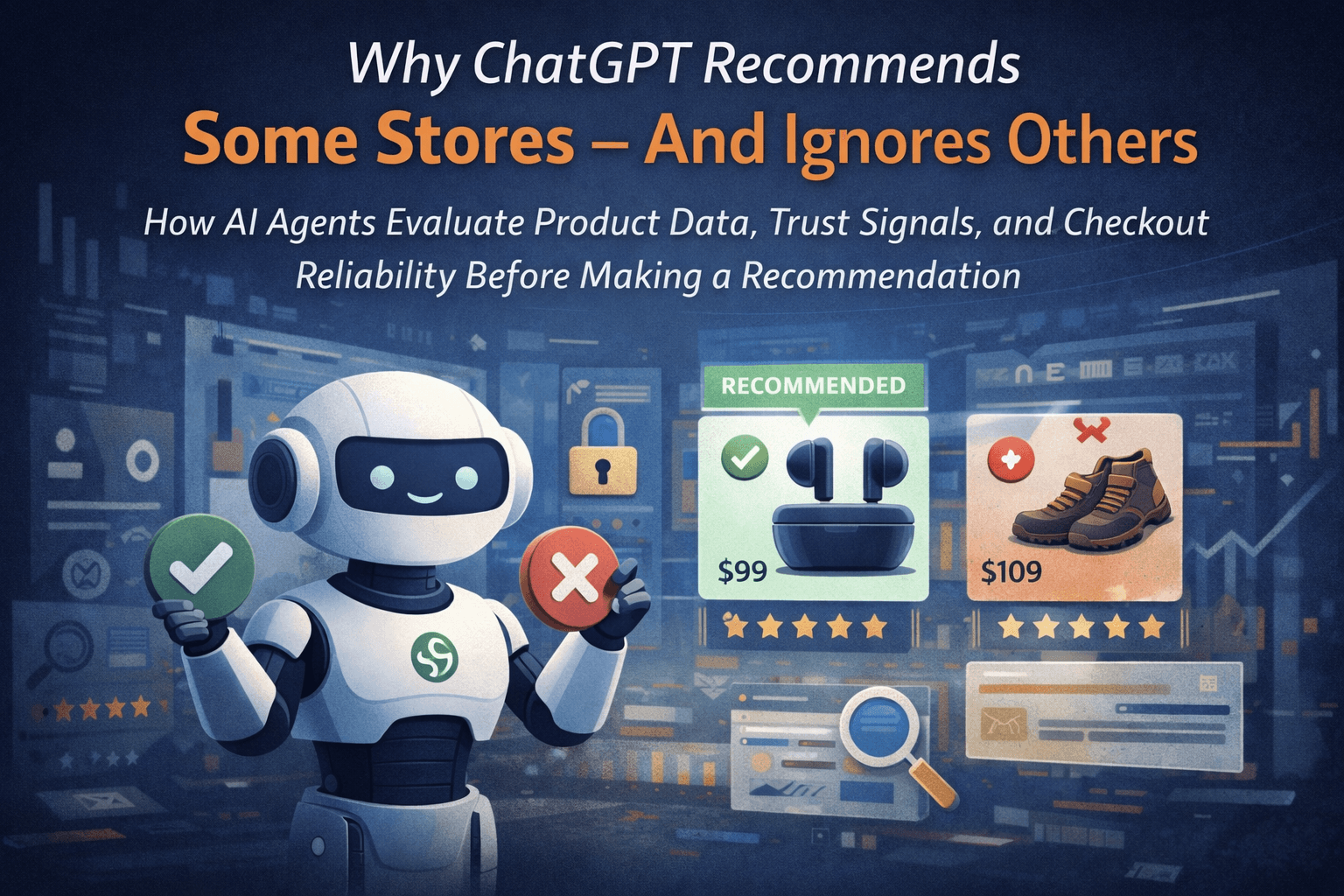
It does not guarantee AI agents will recommend them.
Those are two completely different outcomes.
AI agents don't surface every listed product equally.
They evaluate:
Attribute completeness
Pricing consistency
Inventory accuracy
Schema compliance
ACP and UCP protocol alignment
Checkout execution reliability
If your product data has gaps — missing attributes, inconsistent variants, incomplete specifications — an AI agent will skip you.
Even if you're technically listed.
Shopify's catalog enrichment helps.
But it is not a compliance audit.
It is not a protocol validation.
It does not fix structural data problems.
Getting listed is the entry point.
Getting recommended is the outcome.
They require different work.
What GPTCheckout.ai Does Differently
GPTCheckout.ai was built specifically for this gap.
We are platform-neutral.
We don't compete with BigCommerce.
We don't hold your catalog data as a competitor.
We don't have a commercial interest in your platform choice.
Here is what we do:
ACP and UCP Compliance
We validate your store against both the Agentic Commerce Protocol and the Universal Commerce Protocol — the two active standards AI agents use to evaluate and transact with your store.
If your data doesn't meet those standards, we fix it before you go live.
Catalog Health Audit
We audit every product in your catalog for:
Attribute completeness
Variant consistency
Pricing accuracy
Schema correctness
Agent-readiness scoring
A clean catalog gets recommended.
A messy one gets skipped.
Real-Time Sync
Every inventory change, price update, and product edit in your BigCommerce store is reflected instantly across all AI platforms.
AI agents always see accurate data.
No stale inventory.
No pricing mismatches.
Platform-Neutral Infrastructure
Your catalog data stays on your terms.
No competitor has visibility into your pricing, inventory depth, or product structure.
Your data feeds AI channels directly — without routing through a competing platform's servers.
The Right Question to Ask
Before choosing your path to AI commerce, ask one question:
Am I comfortable with Shopify having full visibility into my catalog, pricing, and inventory — in exchange for free AI distribution?
If yes — Shopify's Agentic Plan is a reasonable starting point.
If no — GPTCheckout.ai gives you the same AI channel access with none of that dependency.
A Note on Timing
This window is genuinely early.
AI-attributed orders on Shopify grew 11x since January 2025.
AI traffic to e-commerce stores is up 7x year-over-year.
Shopping habits formed now will compound for years.
The merchants who get structured and compliant early will own this channel before it gets crowded.
The ones who wait will be fighting for attention in a catalog that already has established winners.
Final Thoughts
Shopify's Agentic Plan is a real product with real distribution.
For Shopify merchants, it's the obvious choice.
For BigCommerce merchants, the trade-off deserves a harder look.
Listed is not the same as recommended.
Free infrastructure is not the same as neutral infrastructure.
Getting into the catalog is not the same as winning in the catalog.
If you want to understand exactly where your BigCommerce store stands — and what it would take to get genuinely AI-ready without routing through a competitor —
👉 Request an Agentic Readiness Audit
👉 Read: What Is the Agentic Commerce Protocol?
👉 Read: Why ChatGPT Recommends Some Stores And Ignores Others
👉 Read: Why Early ACP Adoption Gives BigCommerce & WooCommerce Stores a Competitive Advantage