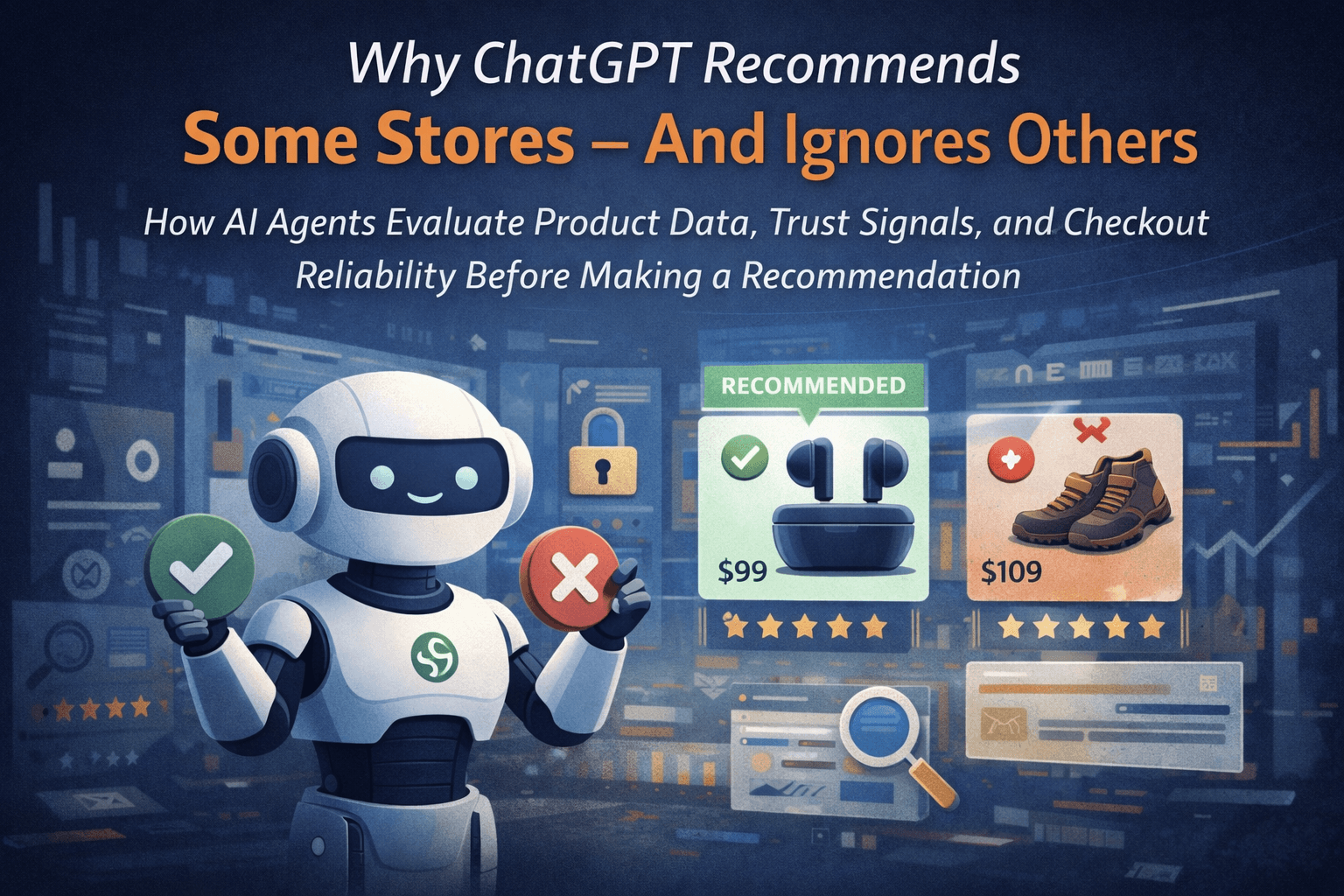
How AI Agents Evaluate Product Data, Trust Signals, and Checkout Reliability Before Making a Recommendation
Why ChatGPT Recommends Some Stores And Ignores Others
Date
Mar 2, 2026
Author
GPT Checkout Team
How AI Agents Evaluate Your Store Before Making a Purchase Recommendation
Many merchants are asking the wrong question.
They ask:
“Why isn’t my store ranking in AI search?”
The better question is:
“Why isn’t my store being selected?”
Because AI agents don’t “rank” stores the way Google does.
They evaluate them.
And evaluation follows a completely different logic.
AI Doesn’t Browse. It Resolves.
When a user asks:
“Best waterproof wireless earbuds under $200”
An AI agent does not:
Open 10 tabs
Compare visually
Scroll endlessly
Click sponsored ads
It performs structured evaluation.
It attempts to resolve:
Product fit
Price validity
Shipping reliability
Return policy clarity
Confidence signals
Checkout stability
If your store cannot resolve cleanly, it is filtered out.
Silently.
The Three Layers AI Uses to Evaluate Your Store
1. Data Clarity
AI systems prioritise:
Structured product attributes
Clear specifications
Consistent pricing
Accurate availability
Machine-readable metadata
If your product details are optimised for humans but ambiguous for machines, you lose.
2. Trust Signals
AI models favour:
Verified reviews
Transparent policies
Clear shipping timelines
Low return friction
Strong historical reliability
If policies are buried in long-form content, trust scoring drops.
3. Execution Confidence
This is where most stores fail.
Even if your product is ideal, the agent asks:
Can this store execute deterministically?
If final cost is unstable…
If shipping recalculates unpredictably…
If taxes cannot be pre-verified…
If checkout logic depends on UI clicks…
The store becomes risky.
And risky options are excluded.
Visibility Without Execution Is Temporary
Many merchants focus only on AI discoverability.
But discovery is just the first filter.
Execution reliability is the second.
And it is more decisive.
You can appear in AI results.
But if your checkout isn’t machine-verifiable,
you won’t be selected repeatedly.
Over time, AI systems reinforce what works.
Stores that execute cleanly get recommended more.
Stores that fail get prioritised.
Why This Matters Now
AI-referred traffic is still early.
But conversion quality is higher.
Why?
Because the decision-making is happening upstream.
By the time someone clicks through from ChatGPT or Gemini, intent is already formed.
That means:
Higher conversion potential.
Lower tolerance for friction.
One ambiguity,
and the session dies.
The New Competitive Advantage
In traditional SEO:
Traffic was the prize.
In AI-driven commerce:
Reliability is the prize.
The stores that win will be:
Structured
Deterministic
Transparent
Machine-executable
Not just optimised.
How ACP Changes This Dynamic
Agentic Commerce Protocol (ACP) introduces:
Pre-flight checkout verification
Deterministic cost confirmation
Machine-readable policies
API-driven purchase primitives
Stable execution handshakes
If you’re new to ACP:
👉 Read: What Is Agentic Commerce Protocol?
If you want to enable instant AI-driven checkout:
👉 Read: How to Enable ChatGPT Instant Checkout on BigCommerce
ACP transforms your store from AI-visible to AI-executable.
That distinction will matter more each quarter.
Ask Yourself This
If an AI agent evaluated your store right now:
Would it trust your execution layer?
Or would it move to a competitor that feels safer?
Final Thoughts
AI does not optimise for persuasion. It optimises for resolution.
The brands that adapt early will compound visibility and trust.
The brands that don’t will slowly disappear from recommendation layers.
If you want to test how AI evaluates your store: