Why Shipping Recalculations, Tax Ambiguity, and Dynamic Pricing Quietly Kill High-Intent AI Transactions
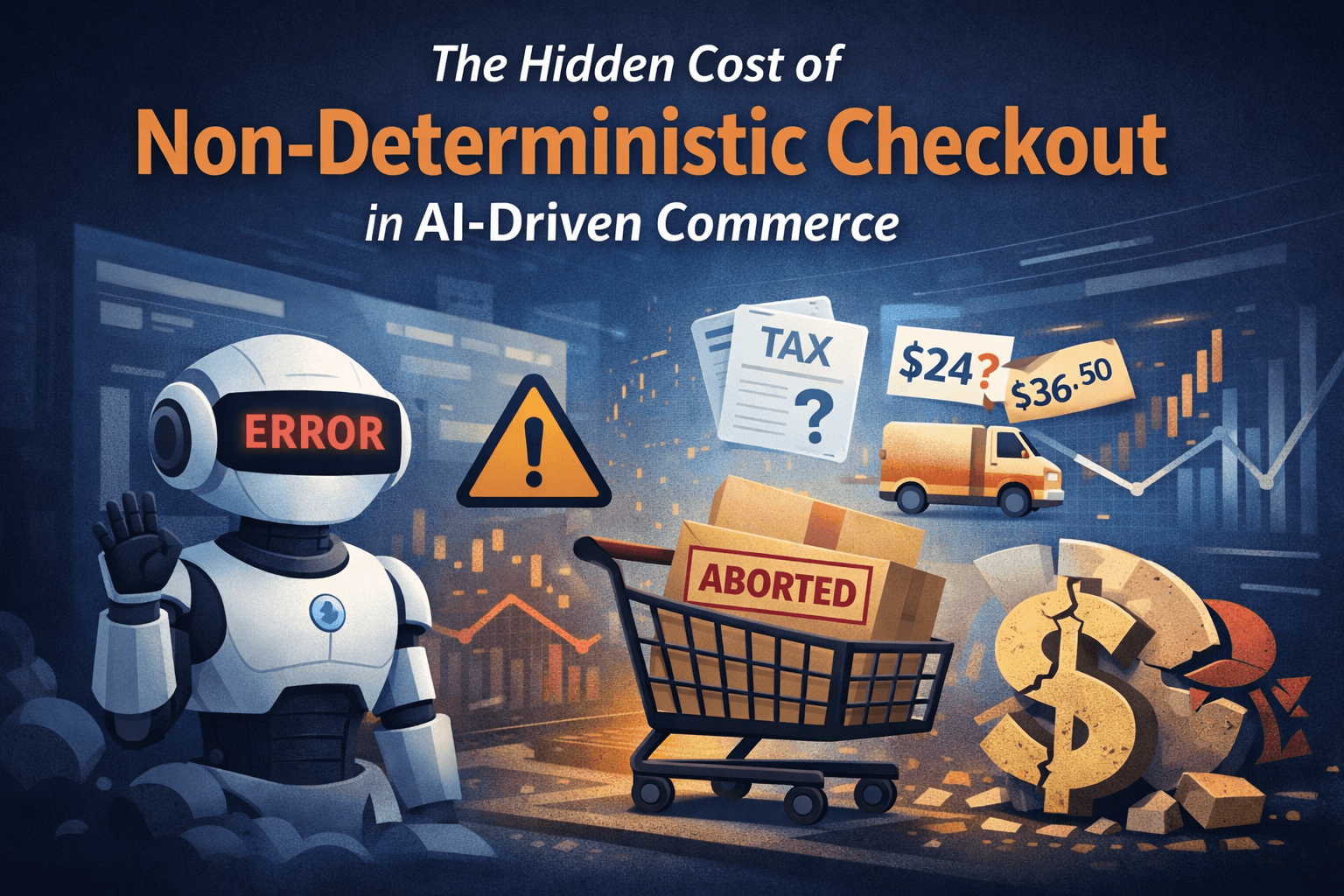
The Hidden Cost of Non-Deterministic Checkout in AI-Driven Commerce
Date
Feb 25, 2026
Author
GPT Checkout Team
The Hidden Cost of Non-Deterministic Checkout in AI-Driven Commerce
Why Most eCommerce Stores Are Quietly Failing AI-Assisted Transactions
Most checkout systems were built for humans.
AI agents operate differently.
And that difference is starting to matter.
As AI assistants like ChatGPT, Gemini, and Copilot increasingly participate in product discovery and even purchasing decisions, a structural issue is emerging:
Non-deterministic checkout logic.
It doesn’t break human conversion.
But it silently breaks machine execution.
What Is Non-Deterministic Checkout?
A checkout is deterministic when:
Final price remains stable once confirmed
Shipping logic is predictable
Tax calculation is verifiable
Inventory is programmatically accessible
No UI-dependent pricing mutations occur
A checkout becomes non-deterministic when:
Shipping recalculates after ZIP entry
Tax updates mid-session
Variant pricing changes post-selection
Dynamic fees inject at confirmation
Policies are buried in unstructured content
Humans tolerate these changes.
AI agents do not.
If the final landed cost cannot be verified programmatically, the transaction aborts.
The “Agentic Abort” Problem
When an AI agent encounters ambiguity in checkout:
It cannot confirm final cost
It flags fiscal risk
It terminates the session
It redirects to a clearer alternative
No complaint.
No retry.
No abandoned cart.
Just invisible revenue loss.
We call this the “Agentic Abort.”
And it’s becoming more common.
Why This Problem Is Growing
AI-driven traffic is increasing.
Recent data shows AI-referred sessions convert at higher rates than traditional organic traffic.
Why?
Because these users (or agents acting on their behalf) arrive with intent already formed.
But higher intent also means:
Lower tolerance for friction.
If clarity is compromised, the session ends immediately.
Real-World Examples of Non-Determinism
Here are common execution failures we see across Shopify, BigCommerce, and WooCommerce:
1. Shipping Recalculation Loops
Dynamic carrier quotes that change after address confirmation create ambiguity.
2. Tax Ambiguity
Localised tax rules that cannot be verified pre-confirmation introduce fiscal risk.
3. Variant-Dependent Pricing
Pricing tied to UI interactions instead of stable API endpoints breaks machine resolution.
4. Fee Injection at Final Step
Handling fees or service charges added late violate deterministic expectations.
Why Humans Don’t Notice (But Agents Do)
Human behaviour degrades gradually.
They:
Refresh
Recalculate
Retry
Adjust expectations
Agents behave differently.
They operate in binary logic:
Valid → Execute
Ambiguous → Abort
This creates a new category of invisible conversion loss.
The Financial Impact
Today, AI-driven sessions may represent a small percentage of total traffic.
But they carry:
Higher intent
Higher confidence
Higher readiness to transact
If your store cannot execute deterministically, that high-value segment disappears.
As AI-mediated commerce grows, this impact compounds.
How ACP Solves Non-Deterministic Checkout
Agentic Commerce Protocol (ACP) introduces:
Pre-flight verification
Stable cost confirmation
Machine-readable policy exposure
API-level purchase primitives
Deterministic checkout handshakes
If you’re unfamiliar with ACP fundamentals, start here:
👉 What Is Agentic Commerce Protocol?
For implementation guidance:
👉 How to Enable ChatGPT Instant Checkout on BigCommerce
ACP does not replace checkout.
It hardens it.
How to Test If Your Checkout Is Deterministic
Ask yourself:
Can final landed cost be confirmed before payment authorisation?
Does shipping remain stable after address validation?
Can inventory be verified via API without UI interaction?
Are tax rules transparently itemised?
Are policies machine-readable?
If any answer is unclear, your store may be non-deterministic.
The Strategic Risk of Ignoring This
Non-deterministic checkout was acceptable in a human-only environment.
It is a structural weakness in AI-assisted commerce.
As more transactions begin upstream in AI-driven conversations, deterministic execution becomes a competitive filter.
Clarity becomes conversion.
Final Thoughts
Non-deterministic checkout is not a UX flaw.
It is an architectural gap.
Today, it affects a minority of sessions.
Tomorrow, it will define market leaders.
If you want to evaluate your store’s execution reliability:
👉 Request an Agentic Readiness Assessment by filling the Contact Us form on GPT Checkout